Animation Cel Preservation
The Engineering Standard
for Animation Cel Preservation.
The first platform to publish the kinetic model, build the diagnostic tools, and design the treatments and products — all from the same equations.
years — the IPI baseline for vinegar syndrome onset under standard room storage. Cels made before 1975 have already crossed it. Most golden-era cels are approaching or inside it now.
Peer-reviewed frameworks, guides, and precision calculators. The math is open and verifiable.
Enter the Hub →Acid extraction, vinegar syndrome conditioning, and laboratory-grade cel certification.
In DevelopmentScavenger inserts, monitoring supplies, and archival storage systems built to the framework.
Shop Products →The 50-Year Window
The classic era of animation
is in the danger zone now.
Animation cels — the hand-painted acetate sheets that made up every frame of traditional animation from the 1940s through the late 1990s — are made from cellulose triacetate (CTA). CTA degrades through an irreversible hydrolysis reaction that is always running. The Image Permanence Institute places the vinegar syndrome onset threshold at 50 years under standard room storage — as few as 38 years under suboptimal conditions. Map that against when cels were actually produced and the implication is immediate: this is not a future concern.
Production year → VS risk in 2026
The Diagnostic Gap
Touch. Sight. Smell.
Three lagging indicators.
In cel collecting, “no vinegar smell” is routinely treated as a clean bill of health. It isn’t. Two mechanisms explain why the standard sensory diagnostics systematically underperform — and understanding them is what separates storage intuition from engineered risk management.
A cel can be in active runaway decay with no detectable odor.
Acetic acid generated inside the polymer matrix doesn’t need to reach your nose
to cause structural damage. Heavy paint coverage — thick acrylic fills, dense vinyl layers —
acts as a vapor barrier. The acid is generated, trapped, and recycled internally rather
than diffusing outward.
Odor measures transport, not damage. A flat, flexible, odorless cel
can already have crossed the 0.5% deacetylation threshold where structural collapse
begins to accelerate. The better the paint layer seals the substrate, the less warning
you get — and the worse the internal accumulation becomes.
Experience accumulates against the survivors — not the full population.
The cels that failed catastrophically in the 1990s and 2000s were discarded.
They are not in collections. They are not on the market. The cels that are still
here have implicitly “proven” the instinctive diagnostic method — but they are
a self-selected sample. The cases that would have falsified the approach are gone.
This isn’t a failure of expertise. It’s a systematic property of how evidence
accumulates in the hobby. Any method calibrated only against survivors will
overestimate its own reliability.
Together, these dynamics explain why the same collector can have decades of experience and still be consistently wrong about borderline cels. It’s not the expertise that fails — it’s the instrument. A-D strips detect acid vapor before odor is perceptible. The VS State Screen classifies damage state from field observables. The kinetic model outputs a quantitative likelihood score tied to your specific environment. These don’t replace experience. They give experience something to measure against.
"By the time you can smell it, you may already be past the point where the outcome is fully reversible. The model exists so you don’t have to wait for the signal."
Acid Transport
Where does the acid go?
Odor measures transport. So a cel's future depends less on the fact that it generates acid — every aging cel does — than on whether that acid has anywhere to go once it reaches the surface. The first three steps are the same in every enclosure: generation inside the sheet, diffusion to the surface, emission into the surrounding air. Only the fourth differs, and it is the one you control.
Ventilation and absorption are not two different mechanisms. Both work by keeping the concentration at the cel surface low, and both fail the same way when they stop doing so. The question worth asking about any storage method is what boundary condition it creates at the cel surface — and whether it can hold that condition for as long as the cel keeps generating acid.
Start here
The framework is open.
The math is published.
Every tier, tool, and product recommendation traces back to the same kinetic model. Start with the frameworks, then use the calculators to score your environment.
Engineering Framework
The governing equations, Arrhenius calibration, and mass-transport model for CTA degradation.
VS Risk Calculator
Enter your cel's A-D reading, age, and storage conditions for a years-to-onset estimate, compared against the IPI baseline.
Knowledge Hub
All guides, calculators, reference papers, and collector resources in one place.
Engineered Products
The hardware built
from the same equations.
Every product is derived directly from the preservation framework — not sourced and relabeled, but designed around the chemistry.
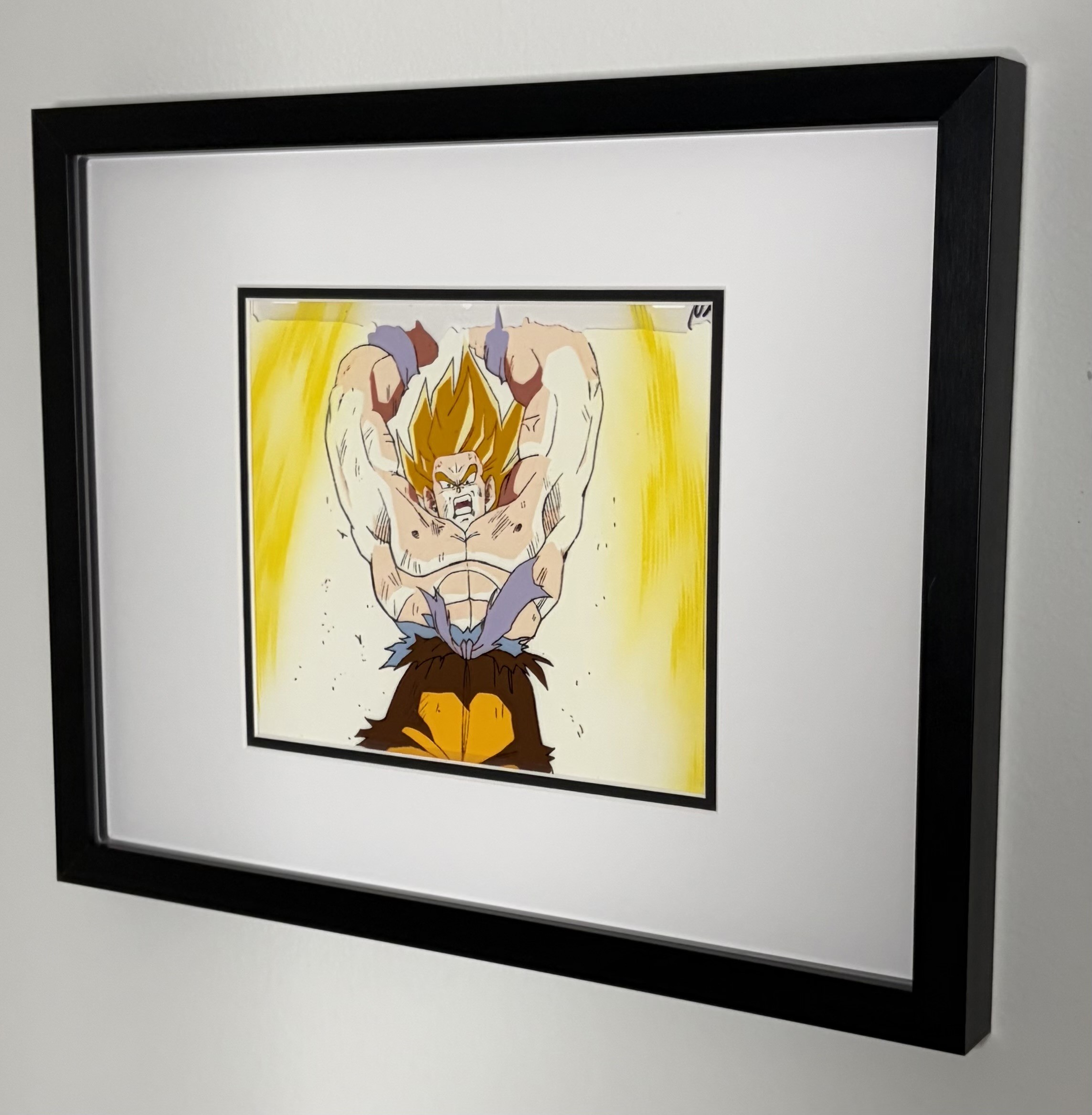
18 × 14″ · $749
- Optium Museum Acrylic — 99% UV protection, anti-reflective
- Art-Sorb active RH buffering — stabilizes internal humidity independent of room swings
- Custom spacer geometry — keeps front Artcare surface exposed and facing the cel, overcoming lateral transport limitations common to conventional framing
- Fast thermal equilibration — frame tracks room temperature directly, so cooling the room cools the cel; the Arrhenius rate reduction applies immediately
- Efficient rear transport path — Artcare backing provides a short diffusion route from the cel back surface when no background is present
- Floating mount — reversible, zero adhesive contact
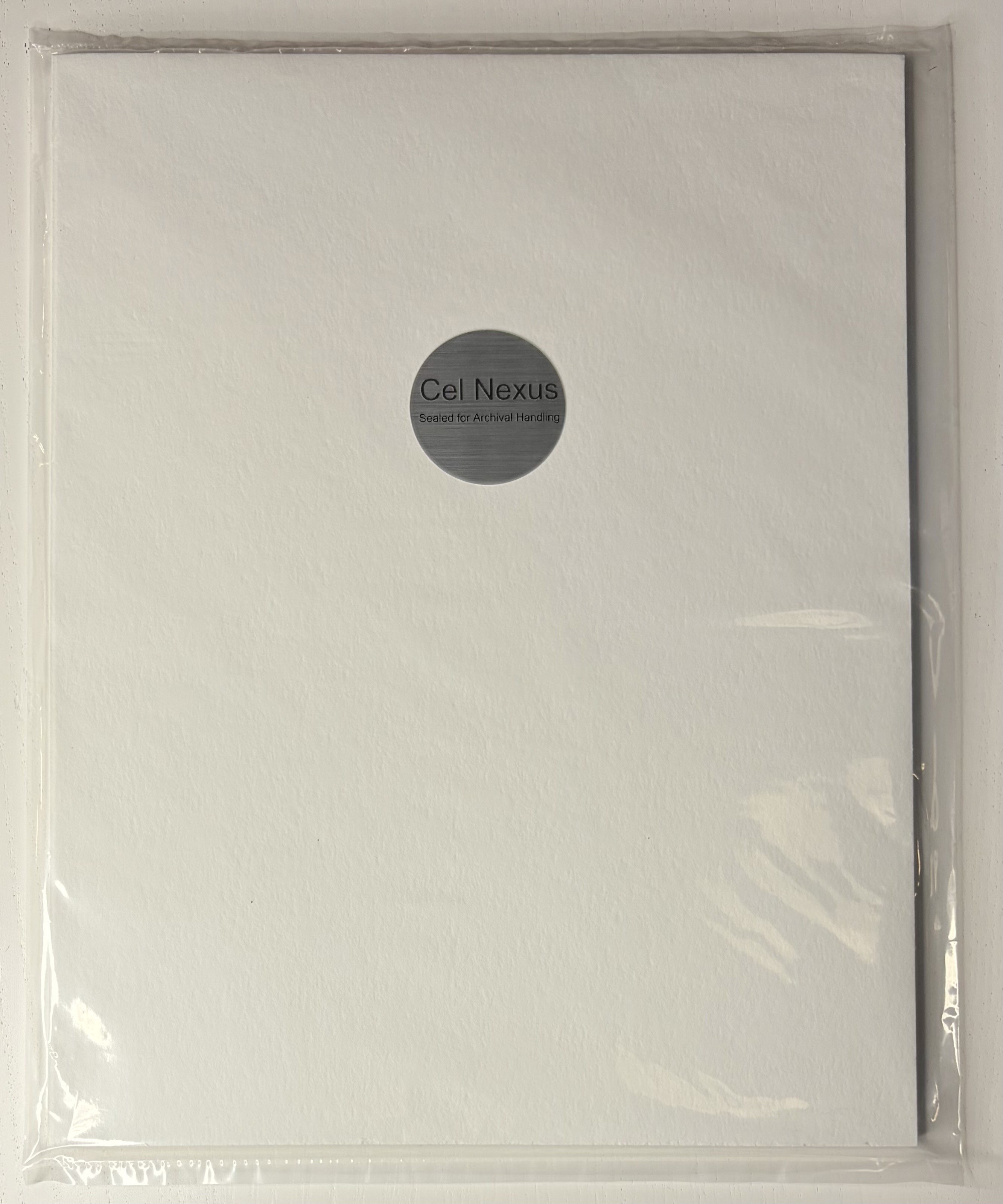
- 2-ply thick board — actively absorbs and neutralizes acetic acid at the source
- Replaces the passive acid-free paper backing in Itoya sleeves — neutral paper holds acid in; this board pulls it out
- Compatible with 11 × 14″ Itoya & presentation binder sleeves
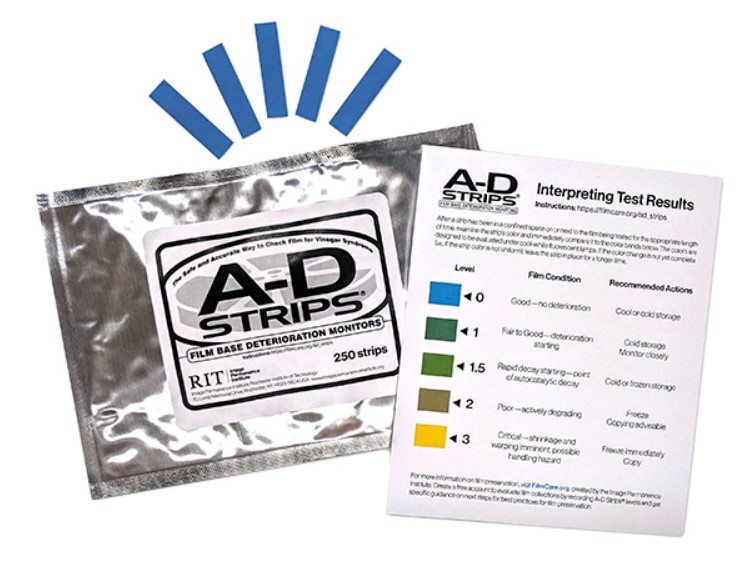
- Color-indicator acid detection calibrated for acetate film
- Detects acetic acid before odor becomes perceptible
- Used in the VS State Screen seal-test protocol
- Quantitative ppm estimation from band color shift