Itoya Preservation Upgrade Kit — How it Works
The goal of this kit is simple: keep the Itoya binder workflow collectors already love, while upgrading the chemistry + mechanics of the storage stack for AD strip Level 0 or 1 (<2 ppm) conditions.
Quick Use Guide
This is the baseline configuration the kit is designed around.
- Cel in polypropylene sleeve: top + right edge cut close to the cel (so diffusion out the opening isn’t blocked).
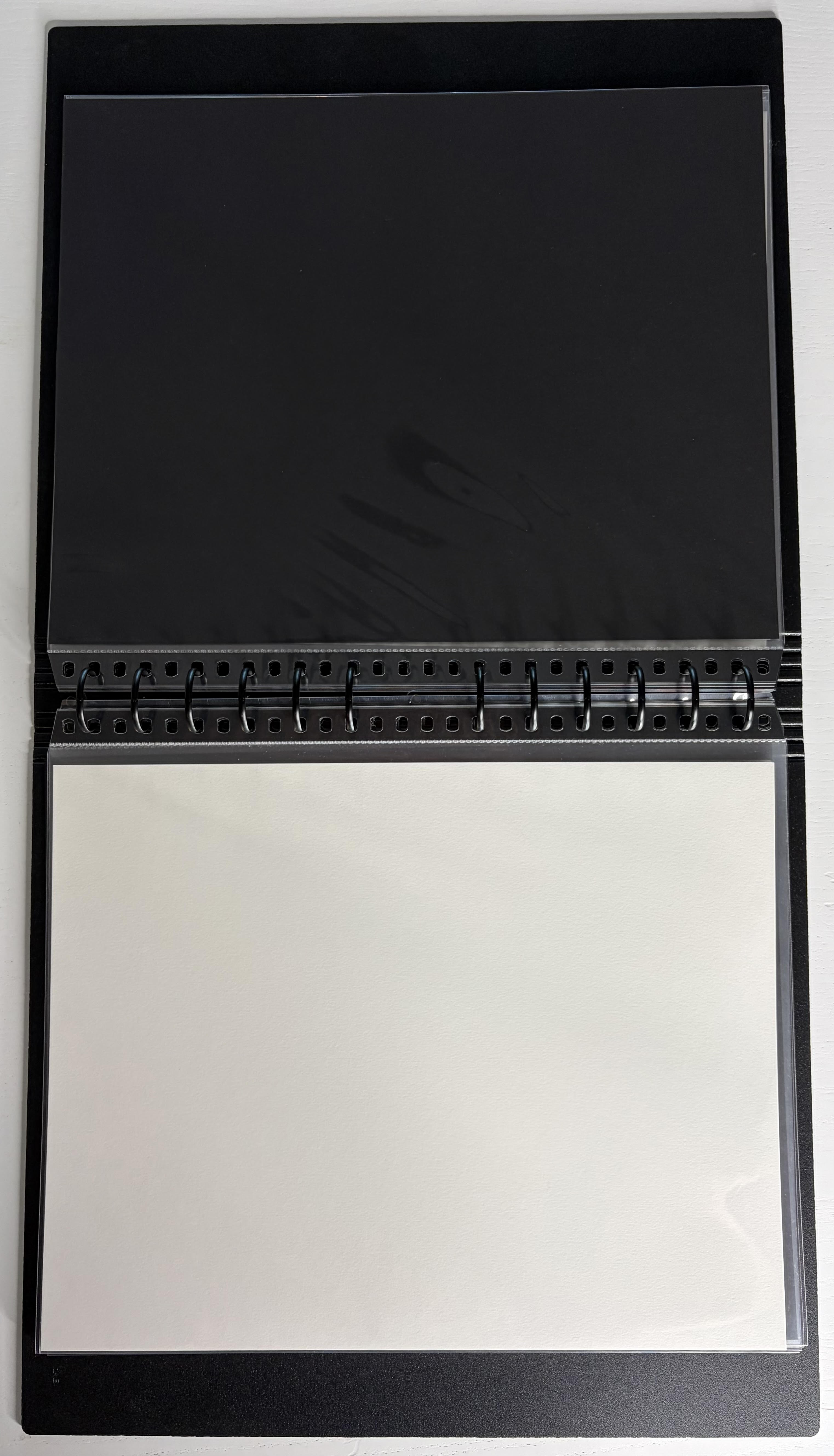
- Board placement: remove the black acid free paper and slide the preservation insert into the Itoya PolyGlass sleeve.
- Cel in polypropylene sleeve placement: slide sleeve into the Itoya PolyGlass sleeve in front of the preservation insert.
- Orientation: store vertical by default; horizontal is supported (see the compression table below).
- Environment: room temperature, controlled humidity (target range per your collection strategy), and avoid heat sources/sun.
- Monitoring: use A‑D Strips periodically; if you’re above Level 1, your strategy shifts from “capacity life” to “reset / containment.”
What It Replaces
The standard hobby stack often looks like this:
Itoya PolyGlass sleeve → black “acid‑free” paper → backing board → polypropylene sleeve → cel
The upgrade stack becomes:
Itoya PolyGlass sleeve → Cel Nexus preservation insert → polypropylene sleeve → cel
Translation: we remove the black paper + backing board and replace them with a single engineered insert that’s thinner and lighter, while also acting as an active sink for trace acetic acid.
Design Intent — What This Product Is, Does, and Why It Matters
The Itoya Preservation Upgrade Kit is not designed to turn a binder into a sealed archive, and it is not a cure for vinegar syndrome. Its purpose is narrower — and more important for everyday cel storage.
This product exists to actively manage acetic acid inside an otherwise open binder system. Itoya binders are popular because they’re practical and familiar, but the standard background materials (black “acid-free” paper and backing boards) are passive. They don’t absorb acid, and they can unintentionally trap it near the cel.
The preservation insert replaces those passive layers with an active acid sink. Once acetic acid diffuses out of the cel’s polypropylene sleeve, the insert reduces how much of that vapor remains in the local micro-environment — lowering the amount that can diffuse back toward the cel surface.
The insert is intentionally oversized so the dominant diffusion path remains out of the polypropylene sleeve openings, not through the board face. The board acts as a nearby sink, not a blocking layer.
From a risk perspective, the most conservative option is still storing without any background at all: fewer materials, fewer interfaces, fewer unknowns. This kit is the engineered compromise for collectors who want page protection and visual consistency while still addressing the chemistry that actually drives cel degradation.
How These Inserts Differ from Buffered Archival Boards
Traditional archival buffered board is an acid-free, lignin-free material treated with an alkaline reserve (typically ~3% calcium carbonate). Its purpose is to neutralize acids that form within paper or migrate into the board over time.
This buffering approach is highly effective for paper-based collections where acid formation is slow and primarily internal to the material.
However, animation cels introduce a different problem.
Cellulose acetate degradation produces vapor-phase acetic acid that off-gasses into the surrounding air. This is not simply an internal pH shift — it is a dynamic vapor emission process.
Buffered board is primarily designed to stabilize material pH. It is not engineered to actively capture or reduce vapor-phase acetic acid concentrations within a confined microenvironment.
Cel Nexus preservation inserts incorporate MicroChamber-style scavenging media, which function as a vapor-phase acid sink. Instead of merely neutralizing acids that contact the board surface, these inserts actively reduce environmental acetic acid exposure within the binder cavity.
In simple terms:
- Buffered board: pH stabilization via alkaline reserve.
- Preservation insert: vapor-phase acid reduction via scavenging media.
For stable cels in the AD Level 0–1 range, controlling the vapor environment is the critical factor. That is the engineering problem these inserts are designed to address.
Consumables, Saturation, and Intended Use
The preservation inserts are consumables. Like molecular sieves or scavenger papers (common ex. microchamber), they have a finite capacity to absorb acetic acid and are meant to be replaced on a predictable interval under low-acid conditions.
This product is intentionally designed for prevention and control, not for sustained containment of high acid generation rates. As AD strip levels increase, the mass of acetic acid being generated rises rapidly — and absorption becomes rate-limited rather than capacity-limited.
Relative Acid Mass by AD Strip Level (Normalized)
To compare levels consistently, the table below assumes a 1 L internal air volume. The absolute volume cancels when comparing levels — what matters is the relative increase in vapor-phase acetic acid mass.
| AD Strip Level | Approx. ppm | Acetic acid mass (µg @ 1 L) |
Relative to Level 0 | Intended Use |
|---|---|---|---|---|
| 0 (Blue) | < 1 | < 2.5 | 1× | Designed baseline |
| 1 (Green) | ~2 | ~5 | ~2× | Supported (prove capability) |
| 1.5 | ~5 | ~12.5 | ~5× | Not intended use |
| 2 (Yellow) | ~10 | ~25 | ~10× | Comparison only |
| 3 (Orange) | ~20 | ~50 | ~20× | Comparison only |
How to Turn AD Level Into a Replacement Interval (Level 0–1 Only)
The table above gives a relative vapor-phase acid mass (and therefore a first-order proxy for “acid load”) for each AD level. For this product we only use that logic from Level 0 → Level 1. Above that, the storage problem shifts toward rate + containment and can become autocatalytic — so a simple “capacity life” estimate stops being the right tool.
Replacement Interval ≈ Baseline Interval ÷ Relative Multiplier
Example multipliers from the table: Level 0 = 1×, Level 1 ≈ 2×.
| Replacement interval frequency at Level 0 | Level 1 multiplier | Recommended interval at Level 1 |
|---|---|---|
| 1 year | ≈ 2× | 0.5 years (twice per year / about every 6 months) |
| 2 years | ≈ 2× | 1 year |
Practical note: because absorption has time lag and AD readings are influenced by placement and test conditions, treat this as a conservative planning tool — not a guarantee.
Compression Benefit (Standard vs Inserts)
Reference baseline: The “standard stack” here matches Configuration A in Vertical vs Horizontal Cel Storage (the full hobby stack), which is the configuration that produces red-tier pressure near the bottom of a filled binder. This section shows how the insert shifts that curve downward.
- Standard stack (Config A): Itoya PolyGlass sleeve + black acid-free paper + backing board + polypropylene sleeve + cel
- Upgrade stack: Itoya PolyGlass sleeve + Cel Nexus preservation insert + polypropylene sleeve + cel
- Standard (Config A): 0.88 mm, 60 g per page
- Cel Nexus insert: 0.58 mm, 48 g per page
Note: Compression risk in a loaded binder is driven largely by fixed loads (especially the Itoya cover/shell) plus constant page components (sleeves/cel/etc.). So the pressure improvement is real, but it’s a secondary benefit. The primary purpose of the insert is acid absorption.
The table below uses the same conservative load model as your orientation analysis (shell load + page-by-page accumulation, 5 cm² contact patch). It’s meant to be a relative comparison — not a claim that every cel will stick above a certain psi. The tier colors are for readability and map to the same “green / yellow / red” framing used in the companion post.
| Page position (from top) |
Standard stack (Config A) (psi) |
Cel Nexus inserts (psi) |
|---|---|---|
| 1 | 0.8 | 0.8 |
| 2 | 1.1 | 1.1 |
| 3 | 1.5 | 1.4 |
| 4 | 1.8 | 1.7 |
| 5 | 2.2 | 2.0 |
| 6 | 2.5 | 2.3 |
| 7 | 2.8 | 2.6 |
| 8 | 3.2 | 2.9 |
| 9 | 3.5 | 3.3 |
| 10 | 3.9 | 3.6 |
| 11 | 4.2 | 3.9 |
| 12 | 4.6 | 4.3 |
| 13 | 4.9 | 4.6 |
| 14 | 5.2 | 4.9 |
| 15 | 5.6 | 5.1 |
| 16 | 5.9 | 5.4 |
| 17 | 6.3 | 5.7 |
| 18 | 6.6 | 6.0 |
| 19 | 7.0 | 6.3 |
| 20 (bottom) | 7.3 | 6.7 |
Result: the insert stack shifts the pressure curve downward, but the improvement is modest because a large portion of the load comes from the binder cover/shell and other fixed components. Treat compression reduction as a secondary benefit; the main intent is to reduce vapor-phase acetic acid exposure. For tier definitions and the Configuration A context, see Vertical vs Horizontal Cel Storage.
What This Product Is (and Isn’t)
- It is: an engineered binder upgrade for stable / low‑grade situations where you’re aiming to prevent acid build‑up.
- It is not: a “fix” for advanced vinegar syndrome. Once you’re above low levels, the problem becomes rate and containment — not just capacity.
- It does: reduce local acetic acid exposure and should reduce autocatalytic “feedback” pressure, assuming diffusion paths are kept open.
- It doesn’t: stop the underlying hydrolysis reaction; temperature and moisture control still matter.