Animation cels are irreplaceable pieces of production history that deserve to be fiercely protected and beautifully displayed. We engineered this system with a single intent: to provide true showcase-style storage. By matching—and often exceeding—the nominal preservation metrics of standard portfolio storage like an Itoya binder, you can confidently elevate your collection out of the dark and onto the wall.
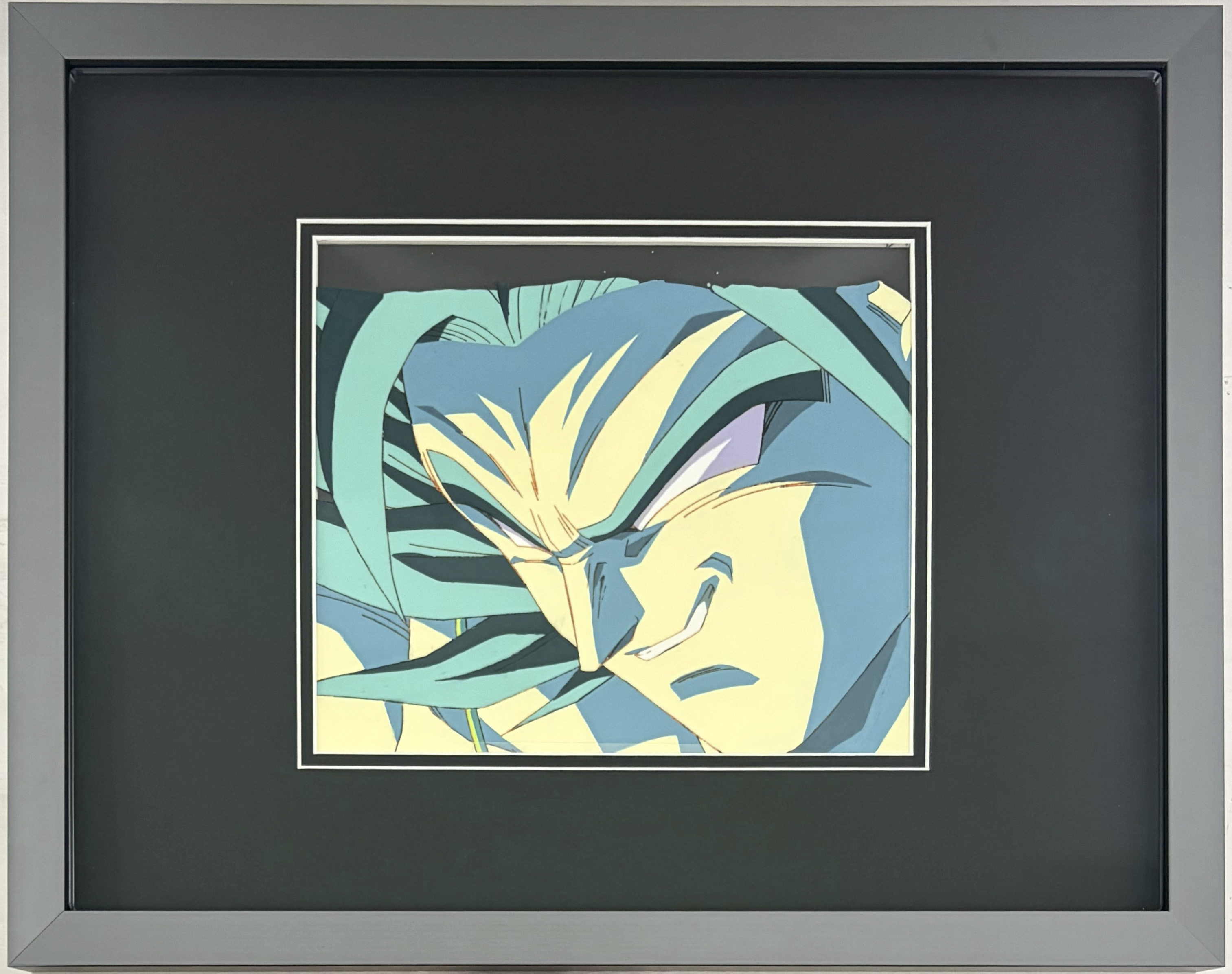
Preview photo currently displays: Standard Edition | Black Frame | Black Outer Accent | Blue Inner Accent
Preview photo currently displays: Premium Edition | Black Frame | Black Outer Accent | Blue Inner Accent
Every layer of our framing system serves a distinct archival purpose.
Comparison of common storage and display approaches based on environmental control, material interaction, and long-term preservation behavior.
| Category | Unframed / Loose | Portfolio / Itoya | Standard Frame | Premium Frame |
|---|---|---|---|---|
| Acid Control | None | None (Incidental; traps off-gassing) | Active scavenging (Artcare) | Enhanced scavenging + dilution volume |
| Active Viewing UV Protection | None | None (When open/viewed) | 99% UV + anti-reflective | 99% UV + anti-reflective |
| Temperature Control | Tracks room temperature | Tracks room temperature | Tracks room temperature | Tracks room temperature |
| Humidity Stability | Directly follows environment | Moderately damped | Highly stable cavity | Actively buffered (Art-Sorb) |
| Mechanical Stress | High risk (handling, bending) | Low (flat storage) | Low (floating mount) | Low (floating mount) |
| Paint Sticking Risk | Variable (contact dependent) | Moderate (direct sleeve contact) | Low (air gap + spacing) | Lowest (controlled cavity) |
| Gas Transport | Random / stagnant | Limited pathways | Engineered diffusion paths | Enhanced surface + volume transport |
| Environmental Isolation | None | Partial | Controlled microenvironment | Buffered microenvironment |
Design Studio
Every frame includes a standard black and white mat set for both the inner and outer positions. Your selected accent colors are added on top of that standard stack, giving you multiple display combinations without changing the preservation build.
Selected Configuration
Addressing the realities, materials, and mechanics of preserving animation cels.
We use aluminum because it has high thermal conductivity and rapid equilibration with ambient temperatures, which eliminates internal "hot zones". Unlike wood assemblies, aluminum also avoids common off-gassing concerns associated with resins, finishes, and adhesives.
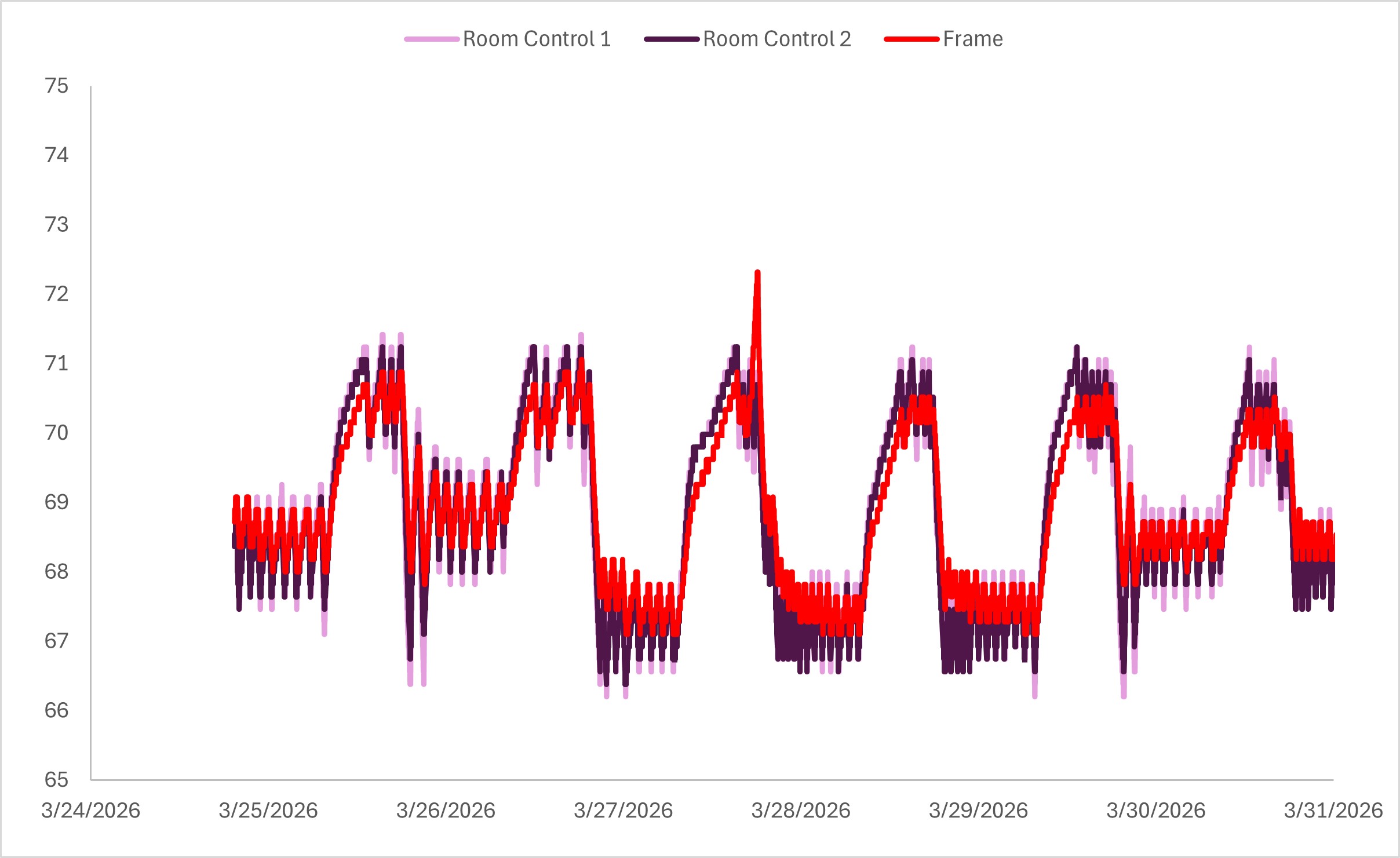
Test Data Validation:
This plot demonstrates the frame's predictable thermal behavior. Over this one-week test, the ambient room (Controls 1 & 2) cycled between ~66.3°F and ~71.3°F (a ~5°F Delta). The internal frame temperature mirrored this swing almost perfectly, tracking between ~67.1°F and ~72.3°F. Because the Delta T is consistent, you can confidently monitor the room environment and know the frame temperature, without requiring internal sensors or worrying about variance.
To prevent paint delamination and sticking, the cel is entirely suspended within the frame, ensuring no painted surface touches the acrylic glazing or the solid backing board. We achieve this through an asymmetric spacing system.
The back of the cel is separated from the main scavenging board by 1/8" of engineered spacing. Because our stress testing revealed the front face of the cel as the primary stagnation weakness, we double the clearance on the front side, providing a full 1/4" air cavity between the cel and the acrylic. This asymmetric design not only physically isolates the paint but significantly increases the internal air volume for acid dilution where the cel needs it most.
These frames are specifically intended for standard Japanese production cels measuring roughly 10-3/8" in width by 9" in height.
Any cel that has been cut to smaller dimensions, or is warped and does not sit flat, requires specialized mounting depth to avoid mechanical stress. For these unique pieces, please consult with us through our Custom Archival Frames option so we can build a proper support system.
Additionally, these frames are designed and optimized for Level 0 A-D strip emitters. While the Artcare™ materials can certainly support higher emitters by actively trapping acetic acid, a frame is inherently not the best environment for an actively degrading cel. Cels emitting at higher levels should ideally be placed in open, isolated, or actively conditioned storage rather than framed display.
Yes. The framing system includes three base window mats, providing inherent physical space to accommodate multi-layered cels without compressing the paint layers. However, from a strict preservation standpoint, we advise separating multi-layer setups.
Stacking cels creates trapped micro-environments that hinder transport dynamics, locking acetic acid between the acetate layers where scavengers cannot reach it. While separation is best for longevity, the frame is engineered for flexibility, allowing you to make the final choice between original multi-layer presentation and optimal preservation.
Yes! It is a common myth that only stark white mats are archival. Every colored mat in our design studio is 100% cotton rag, acid-free, and lignin-free. The pigments used in these museum-grade materials will not bleed, fade, or off-gas, meaning you can safely incorporate vibrant accent colors without risking your cel's chemical environment.
Traditional framing can "clamp" the cel, which increases buckling and edge stress as the acetate naturally shrinks. We utilize Lineco archival mounting strips to cradle the cel with minimal restraint, avoiding zero compression. This floating geometry allows the cel to respond to minor dimensional changes without mechanical tension.
No, their use is highly recommended but ultimately optional. We specify Lineco strips because they provide gentle, reversible support while allowing the cel room for both thermal and hygroscopic expansion across its entire surface area.
Additionally, the physical thickness of the strip creates a micro-boundary layer of air around the perimeter of the cel, which helps prevent edge-compression acid traps. However, our system is highly flexible; if you are uncomfortable applying the adhesive strips to the backing board, you can simply rely on the natural compression of the mat stack to hold the cel in place.
Vintage backgrounds are highly active sources of VOCs and moisture. Pressing a cel directly against a background creates a "stagnation sandwich" that traps off-gassing acetic acid right against the paint, preventing it from ever reaching the frame's buffering materials. Our system is optimized for a single-cel, "floating" display to ensure unobstructed gas diffusion.
There is a misconception that frames need vent holes to "breathe". Experimental studies show that standard paper and board materials reversibly absorb acetic acid, meaning if the ambient concentration drops (like when "airing out" a frame), the acid desorbs right back into the air. Vent holes primarily enable uncontrolled humidity cycling. Instead of venting, our system maintains a stable, low-equilibrium environment by using Artcare™ materials containing MicroChamber zeolites to permanently trap and neutralize the acid internally (Read the Zeolite Technical Paper).
Ideal conditions are 70°F or lower. Because the aluminum frame is designed to trend with the room, you should monitor the room environment, not inside the frame. Remember: colder temperatures mean slower hydrolysis.
The Premium Edition utilizes Art-Sorb to actively buffer against rapid humidity cycles, while the Standard Edition offers mild passive buffering due to its enclosed design. However, no frame is perfectly leak-tight—it will eventually equilibrate with your environment over long periods. Therefore, ambient room relative humidity (RH) should still be managed to a stable 50% ± 5%.
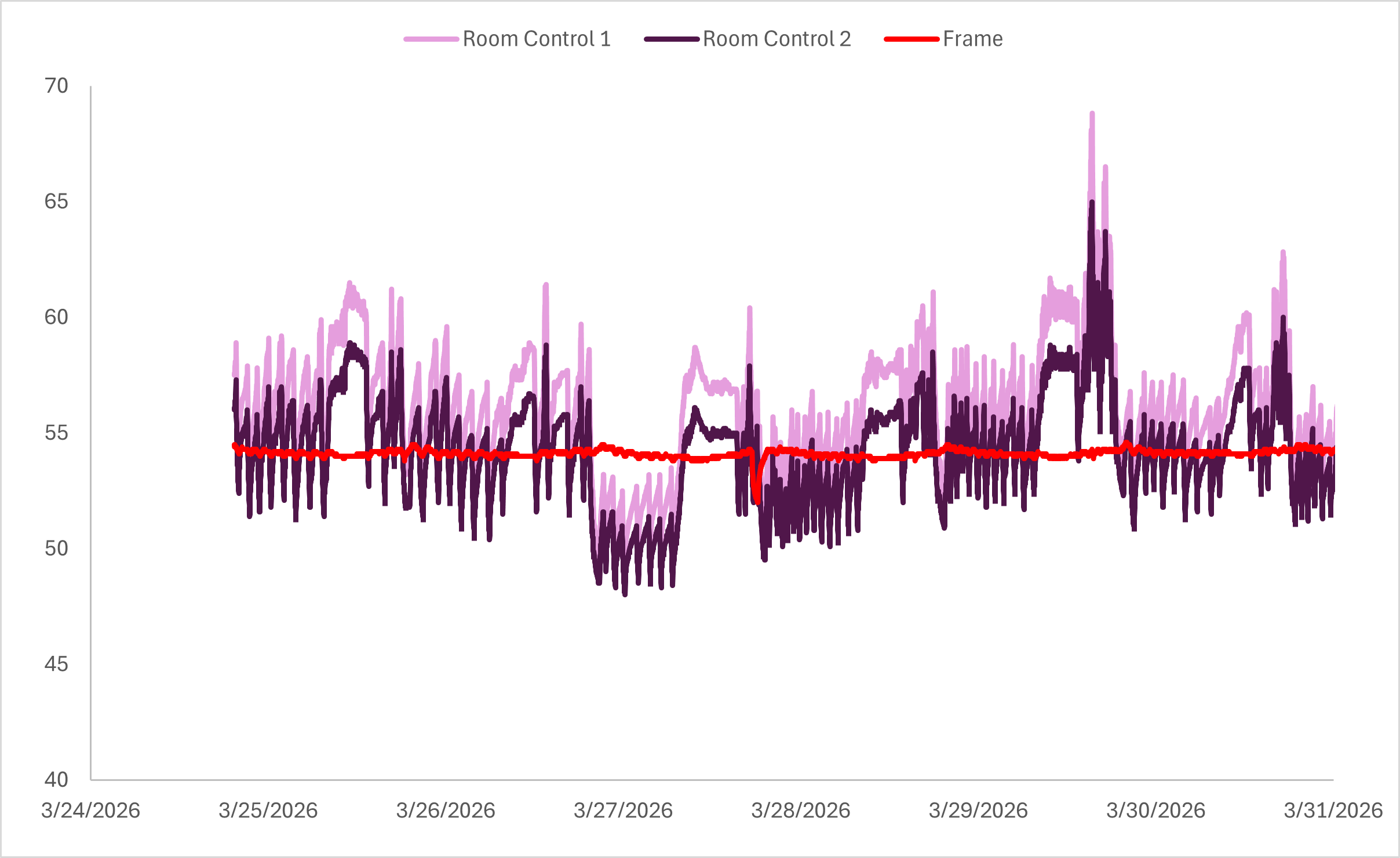
Test Data Validation:
This plot illustrates the aggressive buffering power of the Premium Edition's Art-Sorb layer. During a one-week test, the ambient room experienced massive humidity swings: Control 1 fluctuated between 49% and 68.8% RH, while Control 2 swung from 48% to 65% RH. Meanwhile, the microenvironment inside the Premium Frame remained incredibly stable, only varying between 52% and 54.6% RH. This protects the cel from the rapid hygroscopic expansion and contraction that causes paint to fracture and delaminate.
Conservation or Museum acrylic/glass blocks 99% of UV rays, but extended exposure to visible light still causes fading. Avoid direct sunlight entirely—it heats the frame and accelerates degradation.
We use high-grade acrylic to completely eliminate the risk of shattering. If a frame falls, glass can shatter into shards that will instantly slice through and destroy an irreplaceable cel. Acrylic is shatter-resistant and significantly lighter, reducing structural strain.
Both our Standard and Premium Editions utilize Tru Vue® Optium Museum Acrylic® to provide maximum 99% UV protection alongside anti-reflective optical clarity and anti-static properties.
During development, we rigorously tested more budget-friendly 99% UV acrylics, but we consistently ran into issues that compromised the display experience. Standard acrylics suffer from heavy glare, scratch easily during routine cleaning, and hold static charges that attract dust to the inside of the frame.
Because the Archival Cel Frame is engineered as a zero-compromise showcase piece, we chose to standardize Tru Vue® Optium Museum Acrylic® across both the Standard and Premium editions to ensure the clearest, safest view possible.
Coming Soon: If you are looking for a more accessible entry point, we are actively developing a streamlined Minimalist Display option. This bare-bones frame will maintain our core Artcare™ preservation mechanics but utilize standard 99% UV acrylic, a reduced mat profile, and standard foam backing to offer safe, budget-friendly display.
Replacement intervals are based on conservative maintenance scheduling for the frame’s active preservation materials, not direct prediction of cel condition. Because hydrolysis continues over time, cel emission rate may increase during service life. Routine service therefore focuses on preserving scavenging margin by replacing the backing board and one top unobstructed mat at defined intervals.
Note for Premium Editions: The Art-Sorb sheet must be replaced annually (once a year) to ensure it maintains its active relative humidity buffering capabilities.
Most standard "archival" or "acid-free" framing materials are purely passive. They are neutralized with calcium carbonate to ensure they do not introduce acid into the environment. However, animation cels generate their own acetic acid (vinegar syndrome). Standard passive materials cannot effectively absorb or neutralize this off-gassing.
Artcare™ utilizes proprietary MicroChamber® technology, embedding active zeolites and buffers directly into the material. This allows it to actively trap and neutralize the acetic acid emitted by the cel itself, drastically outperforming standard passive materials in preservation applications.
No, we do not use "black box" marketing terms. Our frames rely on proven, industry-standard Artcare™ technology to scavenge acetic acid. We achieve superior protection through Transport Dynamics—using oversized frames to increase internal air volume for natural acid dilution.
Furthermore, our own internal stress testing revealed that the front face of a framed cel is the most vulnerable to acid stagnation. To combat this, the Premium Edition features a specialized mat window geometry designed to maximize the open surface area, allowing for much more aggressive acid uptake directly from the front of the cel.
This frame is a preservation-oriented display system, not a corrective treatment. It does not stop hydrolysis or correct active vinegar syndrome. The system manages acetic acid emissions after they are released. Preservation is environmental control first; you must maintain stable temperature and humidity, as no frame can override physics.
You can, but it is not highly effective for continuous monitoring without compromising your display.
Because the Artcare mats and backing actively scrub acid, placing an A-D strip against or behind the matboard will artificially skew the reading. As our stress testing revealed, the front face of the cel (the airspace between the cel and the acrylic glazing) is where acid clears the slowest. To get an accurate reading, the A-D strip would need to be suspended in this front viewing window, which significantly impairs the visual presentation of your artwork.
The aluminum frame body can be wiped with a clean, dry microfiber cloth. For the Optium Museum Acrylic, use an acrylic-safe cleaner and a soft, dedicated microfiber cloth. Never use ammonia-based cleaners (like standard Windex) or paper towels, as they can scratch the surface or degrade the anti-reflective UV coatings.
The frame is designed for easy, stress-free assembly at home. Our goal is to provide a complete mounting kit with every order—including the specific screwdriver needed—so absolutely no additional tools are required on your end. (Detailed assembly instructions coming soon!)